

Smarter routing system for reliable last-mile delivery.

Smarter routing system for reliable last-mile delivery.

Smarter routing system for reliable last-mile delivery.

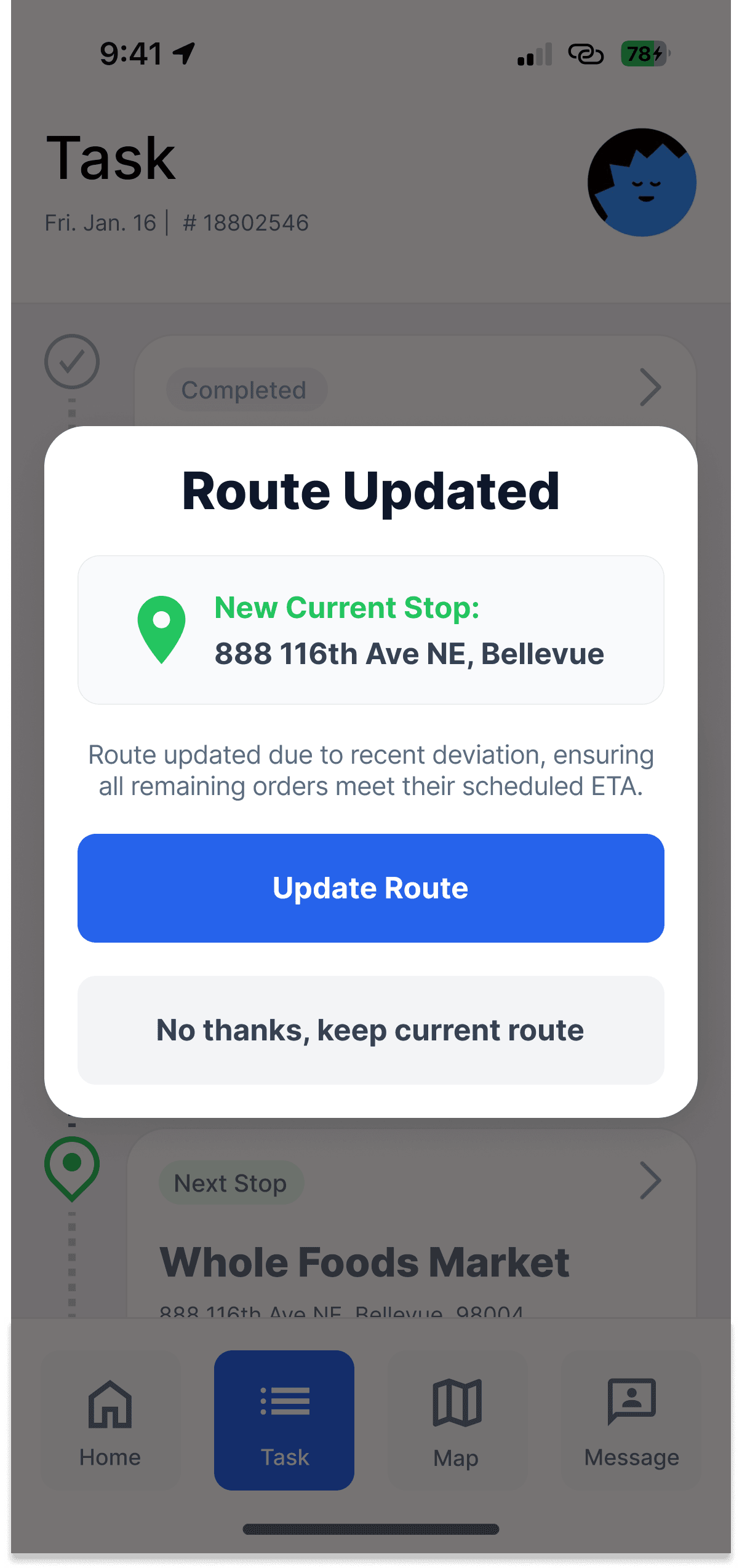
I designed a mobile experience that keeps drivers aligned with changing routes, updated tasks, and next-stop navigation.
ROLE

Solo Product Designer

Solo Product Designer

YEAR

09.2025-03.2026

09.2025-03.2026

TYPE

Industry-sponsored Capstone

Weather app image
Weather app image
Weather app image

Overview

Overview

Overview

Fleeton is a 6-month project sponsored by T-Mobile for Business, a 5G-powered system that reroutes last-mile deliveries in real time. Routes are planned before departure — but once drivers are on the road, ETA shifts, deviations, and stop delays pull that plan out of sync.


Engineering could compute a new route. I designed the layer that makes it usable at the wheel — helping drivers grasp what changed and what to do next in seconds, eyes on the road.

Problem

Problem

Problem

Last-mile delivery systems plan routes before departure, but cannot adapt to real-world execution.

When drivers face route deviations, stop delays, traffic changes, or unexpected incidents, the original route can quickly become outdated. Without timely updated guidance, drivers must handle these changes manually, increasing the risk of late deliveries and unreliable ETAs.

But "routes break" was our hypothesis, not yet a finding. Before designing anything, I needed to know exactly where they break — and for whom.

Research

Research

Research

Fleets don't lack data. They lack interpretation the moment things change.

Primary

Interviews — T-Mobile network engineers & enterprise sales

[N] sessions · 10-question semi-structured protocol

Secondary

Frontline workflow reconstruction — UPS dispatch stack (ORION · DIAD · DMS)

Day-in-the-life journey map · 8 pain points — 4 dispatcher, 4 driver

Market

Competitive scan — Samsara, Motive, Verizon & AT&T fleet offerings

Positioned on cloud ↔ edge × dispatcher ↔ driver

Synthesis produced five insights. The three that shaped the driver-facing design

Scope: three signals break a route (ETA shift · deviation · stop delay); only a deviation is decided at the wheel. That decision, made possible by edge latency, is what everything below designs for.

Synthesis produced five insights. The three that shaped the driver-facing design

Scope: three signals break a route (ETA shift · deviation · stop delay); only a deviation is decided at the wheel. That decision, made possible by edge latency, is what everything below designs for.

Solution

A T-Mobile 5G-powered system that detects on-road incidents and dynamically reroutes deliveries to keep ETAs reliable.

The system proposes the reroute. The driver decides. My design makes that call fast to read, easy to trust, and safe to make at the wheel.

  1. Glanceable alerts

What changed, the ETA impact, one action — read at a glance.

2. Explained, not just pushed

The app says why it's rerouting and what it protects, so the change is easy to trust.

3. The driver's call

Reroutes are proposed, not forced — the driver accepts or keeps their route.

Solution

Solution

A T-Mobile 5G-powered system that detects on-road incidents and dynamically reroutes deliveries to keep ETAs reliable.

A T-Mobile 5G-powered system that detects on-road incidents and dynamically reroutes deliveries to keep ETAs reliable.

The system proposes the reroute. The driver decides. My design makes that call fast to read, easy to trust, and safe to make at the wheel.

  1. Glanceable alerts

What changed, the ETA impact, one action — read at a glance.

2. Explained, not just pushed

The app says why it's rerouting and what it protects, so the change is easy to trust.

3. The driver's call

Reroutes are proposed, not forced — the driver accepts or keeps their route.

03 — The reroute decision

Auto-rerouting was the efficient default. I made it the driver's call.

A driver sees what the system can't — a blocked street, a waiting customer. So the app proposes the reroute, explains why, and leaves the call to the driver.

Weather app image

1. Real-Time Issue Detection

Surfaces high-signal operational changes — such as ETA jumps, route deviations, stop delays, and special-case exceptions — when they start affecting route reliability.

2. Edge-Enabled Decision Support

Uses private 5G and edge-side processing to help logistics teams detect issues faster, reduce update latency, and keep route status aligned with live conditions.

3. Guided Driver Actions

Translates complex operational signals into simple next steps for drivers, such as confirming status, adjusting route behavior, or escalating to dispatch when human coordination is needed.

Tested under driving load

Tested under driving load

I tested the alert interaction with 6 participants in a driving simulator, measuring whether handling an alert caused lane deviation, collision, or eyes-off-road beyond 2 seconds.

83%

kept eyes on the road

5/6

no UI-caused incident

83% maintained road focus during alert interactions · 5/6 passed with no UI-caused incidents


What the test changed

without audio cues, drivers polled the screen between alerts — so audio notification became a top design priority for the next iteration.

Outcome

Outcome

Outcome

We delivered Fleeton, a high-fidelity driver-facing MVP for real-time route execution. The experience helps drivers respond to route changes through focused alerts, synchronized task updates, and clear next-stop navigation.

  1. Driver-Facing MVP

Designed the core iOS flow for route update alerts, task list synchronization, and next-stop map guidance.

  1. Execution Visibility

Mapped how live route signals such as ETA shifts, deviations, and stop delays translate into driver-facing updates.

  1. Safety-first interaction model

Defined the propose-confirm interaction model that lets drivers accept or keep their route without leaving the driving context.

  1. Driver-Facing MVP

Designed the core iOS flow for route update alerts, task list synchronization, and next-stop map guidance.

  1. Execution Visibility

Mapped how live route signals such as ETA shifts, deviations, and stop delays translate into driver-facing updates.

  1. Safety-first interaction model

Defined the propose-confirm interaction model that lets drivers accept or keep their route without leaving the driving context.

Create a free website with Framer, the website builder loved by startups, designers and agencies.